Types of charging

Whilst the numerous ways of charging means you’re never really likely to be without a source of power, it can appear a little daunting until you get your head around the different types of chargers and how they differ.

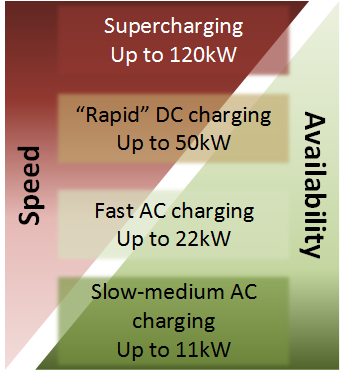
We’ll break it down into five different categories:

Each category has its particular characteristics, plus points and downsides which are covered below. The UMC – which uses the extension leads and adaptors available from this website – is covered in the last section.

Supercharging

Supercharging really is the fastest way to charge your Tesla. It can offer up to 120kW of power and, in ideal conditions, will half charge your car’s battery from nearly empty to around 50% in approximately 20 minutes.As your car’s battery fills up, the charge speed will slow down. Whilst 20 minutes will take you from <10% to 50% state of charge, a further 20 minutes will take you from 50% to 80% and a further 35 to 40 minutes will be required to complete the last 20%.

Also, please be aware that charge speed is not only related to the current state of charge of the battery, but also battery temperature. If the battery is cold (under 20 degrees celcius), then the charge speed will initially be limited until the battery warms up. One indication that the battery is cold is the dotted yellow line on the power dial indicated limited regenerative braking: if any of this section is dotted yellow, then the power the car’s battery can take will be limited to this amount.

Supercharging’s primary objective is to allow you to recharge rapidly en route, providing minimum downtime before giving you sufficient charge to complete the next leg of a journey.Whilst the most powerful and rapid form of charging available, it’s also the least abundant. Owners should only ever use these bays whilst charging and move their vehicile as soon as they have enough charge to free up the slot for the next Tesla owner.

For more information about Supercharging, including the rollout of Supercharger stations across the world, please see the updated pages on Tesla’s website.

Rapid DC charging via CHAdeMO adaptor

The term “Rapid DC charging” is used for charging stations offering up to 65kW DC power.

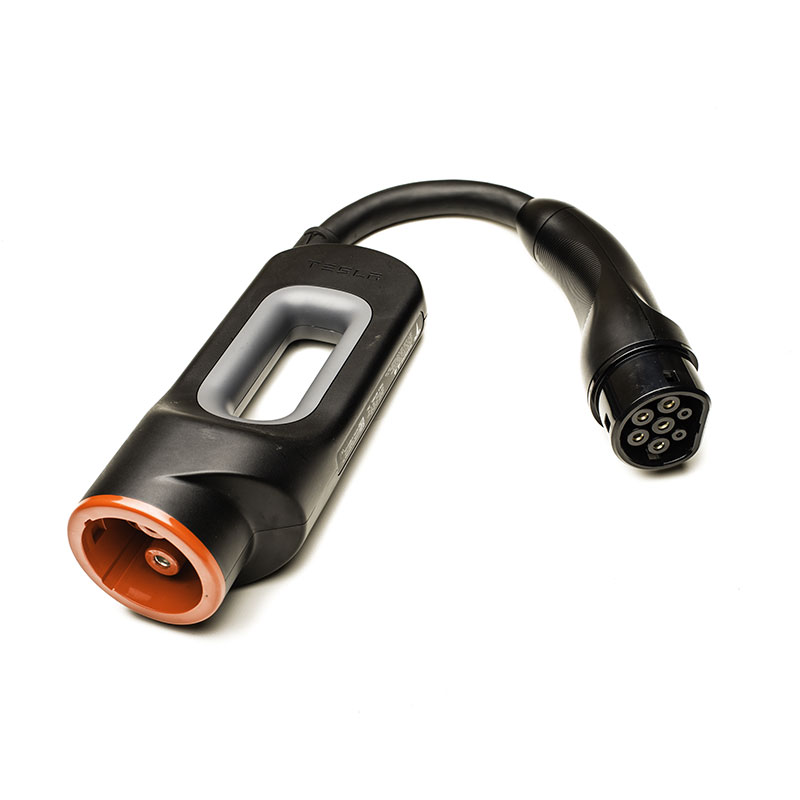
CHAdeMO is in fact a trade name and an abbreviation for “CHArging de MOve”. It uses a different bulkier connector than the “Type 2” found on Tesla cars. As a result, a CHAdeMO adaptor (pictured right) is required to use with these rapid DC charging stations and can be purchased directly from Tesla. It costs approximately £400.

It is found quite commonly across Europe, with around 300 charge points in the UK, another 300 in France, 500 in Holland. Some of these chargers will require either an RFID card, a mobile phone app or some other method of activating.

In the UK, the Electric Highway network run by Ecotricity can be found at all the motorway service stations and as of March 2020 requires the usage of an app and costs 30p per kWh.

In France, you can get a KiWhi Pass card which will allow the usage of CHAdeMO chargers at Auchan supermarkets. More information here.

CHAdeMO is likely to reduce over time as more CCS rapid chargers become available. CCS is the standard rapid charging adopted across Europe. Also, the Model 3 does not support CHAdeMO Rapid DC charging.

Tesla CHAdeMO Adaptor
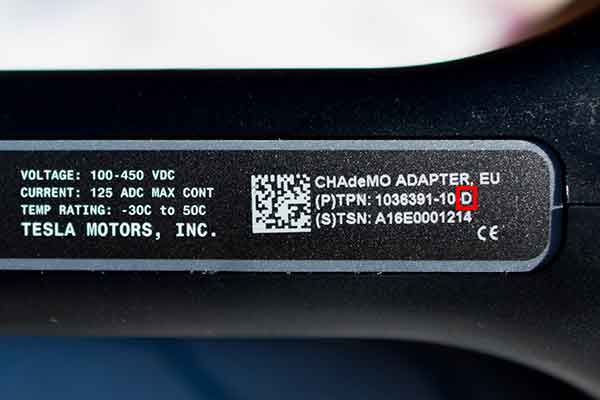
Revision D CHAdeMO adaptor

Note: If you have a “facelift” Model S or X and are considering buying a CHAdeMO adaptor second hand, please ensure it is revision D or later (there’s a “D” suffix on the part number) otherwise there might be instances with certain chargers where the car fails to work. A “software-updated” revision C isn’t sufficient – you need the new modified hardware found in the revision D. This is due to an interference problem on certain old CHAdeMO charge points which a “D” version works around with additional filtering circuitry.

Rapid DC charging via CCS

All Model 3 cars come with a Type 2 CCS socket on the car. CCS stands for Combined Charging System and is essentially a Type 2 (or 1 in the US) charge port with two additional pins beneath the main circular connector providing high-powered DC connections.

Recent Model S and Model X cars can charge via CCS but they require a specific Tesla adaptor that converts the CCS charging lead to a Type 2 one. If your Model S or X was not delivered with a CCS adaptor, then some additional hardware is required. Tesla can offer the hardware upgrade and CCS adaptor at a bundle price. Please check with Tesla directly to confirm availability for your car with your VIN.

Fast AC charging via Type 2 charge points and Tesla Destination Chargers – up to 22kW

The Supercharger and CHAdeMO systems are both DC-based charging – they feed the batteries the direct current required to charge them. When it comes to AC charging, the batteries need to have the alternative current converted to direct current using the on-board chargers in the car. The power these onboard chargers can use varies depending on the specification of the car.

For pre-facelift Model S cars, there were two options:

  • Standard charger providing up to 11kW power via 16A three-phase power
  • Dual charger providing up to 22kW power via 32A three-phase power

For the more recent facelift cars, there are now two options:

  • Standard charger providing up to 11kW power via 16A three-phase power, same as the pre-facelift version
  • “High power” charger providing up to 16.5kW via 24A three-phase power

The above determines the maximum the car will be able to charge at. If you plug into a Type 2 charger capable of providing 22kW, you might only charge at 11kW or 16.5kW depending on the specification of the car. If you have a facelift car without the high power charger option, this can be software-enabled by purchasing the option from Tesla. It is, however, relatively expensive, and given the modest gains potential provided – a jump from 11kW to 16.5kW ONLY if the charge point supports it – I would suggest purchasing the CHAdeMO adaptor first as you’ll benefit from it far more frequently and the gain in speed is massive (11kW AC to 50kW DC).

However, as well as the car potentially determining how fast it charges, the power source / charge point can also be a contributing factor to charging speed…

As a side-note, if you come across a charger offering “Rapid AC” at 44kW in addition to the 22kW “Fast AC”, etiquette would suggest taking the slower one, leaving the faster 44kW version to cars which can benefit from it.

Type 2 charge points

These charge points exist in various power outputs, from a very lowly 4kW (16A single-phase) all the way up to 22kW (32A three-phase). Charge points will either be “tethered” where the cable connecting to the car is an integral part of the charge point or “untethered” where they present a socket for which you will need to provide your own charging cable.

Tesla sell a very good 7.5m long 32A three-phase Mennekes branded blue coloured cable for around £180 inc VAT. This would be my personal preferred solution and what I use when charging from untethered charge points. With this cable, you’ll always be able to charge at the maximum speed determined by the charge post and car configuration. Be aware that cheaper cables might only be capable of providing 16A or might only be single-phase which can be a limiting factor regardless of charge point power availability and car configuration!

Tesla Destination Chargers

Tesla are also rolling out their own Type 2 charger as part of the “Destination Charger programme”. It’s effectively a Type 2 charge point that will work with your Tesla vehicle. The main benefit is they are all tethered so no need for you to have your own cable and they are normally free, although access is controlled by the venue they are located at. You can see the list of destination chargers on Tesla’s website, here, and also from the navigation screen in car.

Destination chargers can provide up to 22kW depending on the venue. Details of power available and other facilities offered by the venue are shown on the car’s screen.

Home charging

When it comes to charging your Tesla at home, you have a few options. You can use the UMC (see below), but this can be tedious if you unpack and repack it in your car every day. Several home chargers can be installed, some of them available under the ULEV grant.

The choice of chargers is rather large, and like for public charging, you can choose between tethered and untethered options. Tethered will be slightly more expensive but offers the convenience of just plugging the car in with no cable to put away afterwards. On the other hand, untethered can be useful, particularly if your household uses another EV which has a charging socket that’s not a Type 2. In this case, you can just plug in the appropriate charging cable for the car in question, making it a more flexible solution, although obviously only one car can charge at a time from a single charger point.

Tesla also offer a “HPWC”, a high power wall connector. This is the same as the charge point used in their destination charger programme – a convenient tethered post. Its advantages are that it arguably looks nicer and has the charge port flap release button on the end of the plug. The downside is that it is not available under the ULEV grant, so you will have to buy it (around £500) and then pay for the installation yourself.

Charging with the UMC

The Universal Mobile Connector, or UMC, is the small portable charge point that comes with the car. It effectively allows you to provide a source of AC power and it will then interface to the car’s charger, converting the AC to DC and charge the batteries.

As of May 2019, there are now two different UMCs Tesla have provided. A “Gen1” which was shipped with all Model S and X cars till around May of 2019, and all future deliveries appear to come with the “Gen2” device, and that includes all Model 3 deliveries.

The Gen1 UMC has a maximum charging power capacity of 11kW when fed with a 16A three-phase power source via the red Tesla industrial plug adaptor. This can be used as an alternative to the 32A single-phase blue adaptor and 13A UK plug adaptor Tesla provide as standard with the car. The small unit manages the charge session and you have approximately 5m cable length to the Type 2 plug which connects to the car.

The Gen2 UMC has a maximum charging power capacity of 7kW when fed with a 32A single-phase supply source via the (optional) blue Tesla industrial plug adaptor – it’s the 16A CEE Commando adaptor that’s supplied with the car, not the 32A one.

Also, please be aware that the Gen1 32A blue adaptor and UMC work in a particular way that is only compatible with Tesla cars: the 32A is presented as three lots of 10.6A to each of what would otherwise be three different phases. Whilst this is fine for Tesla, you must never use the blue adaptor and UMC to charge another car equipped with a Type 2 socket – bad things can happen!!! Renault Zoë cars have been severely damaged this way. This configuration is most certainly not a standard Type 2 charging mode! The Gen2 UMC’s optional 32A adaptor should be OK as it appears to comply to the standard connectivity used in the Type 2 plug.

Going places – charging across Europe

The fact that the UMC supports different adaptors also means you can buy an adaptor to match the domestic power socket of that European country you want to visit. Tesla make a whole range of adaptors for Schuko, France, Italy, Switzerland, etc, ensuring you can plug in at that B&B or hotel even though it doesn’t have a proper Type 2 charging point.

This might be suitable if you’re only going to one country, however, consider that each different Gen1 UMC adaptor costs around £90 from Tesla and you might still have a cable length issue: if the power socket is more than around 5m from where you can park your Tesla, the UMC’s cable won’t be long enough to reach. If you would like more flexibility and know that only a single kind of extension lead would be required regardless of power socket type, then you might want to look at our charging cables solution.

What charging speeds can I expect?

The charging speed provided by Tesla is just an indication on how many miles or km you will gain per hour of charging. Your actual charge speed will depend of course on your driving circumstances. Charge speeds are calculated on an average energy usage of approximately 330 Wh/mile or 200 Wh/km.

The table below shows approximage distance gained per hour of charge depending on the charge current which you can control from the touchscreen. When using the Xavelec charging system with the Tesla 16A 3-phase red UMC adaptor, the car will by default pull 16A current. However, the socket you use might be limited to 10A, so remember to reduce the charge current if this is the case.

All adaptors which are limited to 10A come with a label reminding you to reduce the charge current.

  • Current
  • 16 A
  • 13 A
  • 10 A
  • 8 A
  • 5 A
  • 16 A
  • 13 A
  • 10 A
  • Voltage
  • 233 V
  • 233 V
  • 233 V
  • 233 V
  • 233 V
  • 233 V / 415 V 3-phase
  • 233 V / 415 V 3-phase
  • 233 V / 415 V 3-phase
  • Power
  • 3.7 kW
  • 3 kW
  • 2.3 kW
  • 1.8 kW
  • 1.15 kW
  • 11 kW
  • 9 kW
  • 7 kW
  • Speed
  • 14 km/h – 9 mph
  • 12 km/h – 8 mph
  • 9 km/h – 6 mph
  • 7 km/h – 5 mph
  • 4 km/h – 2mph
  • 45 km/h – 28 mph
  • 38 km/h – 24 mph
  • 30 km/h – 18 mph
Save & Share Cart
Your Shopping Cart will be saved and you'll be given a link. You, or anyone with the link, can use it to retrieve your Cart at any time.
Back Save & Share Cart
Your Shopping Cart will be saved with Product pictures and information, and Cart Totals. Then send it to yourself, or a friend, with a link to retrieve it at any time.
Your cart email sent successfully :)